Temperature-sensitive cargo — fresh produce, frozen seafood, pharmaceuticals, chemicals — cannot travel in a standard dry container. A reefer container is a self-contained refrigeration unit that actively maintains its interior within a precise temperature band from origin to destination. Get the setup right and cargo arrives intact; get it wrong and you face spoiled product, complex insurance claims, and the cost of a replacement shipment.
This guide covers what you need to know before you book: the hardware, the documentation, the cost drivers, and the planning moves that keep the cold chain unbroken.
What Is a Reefer Container?
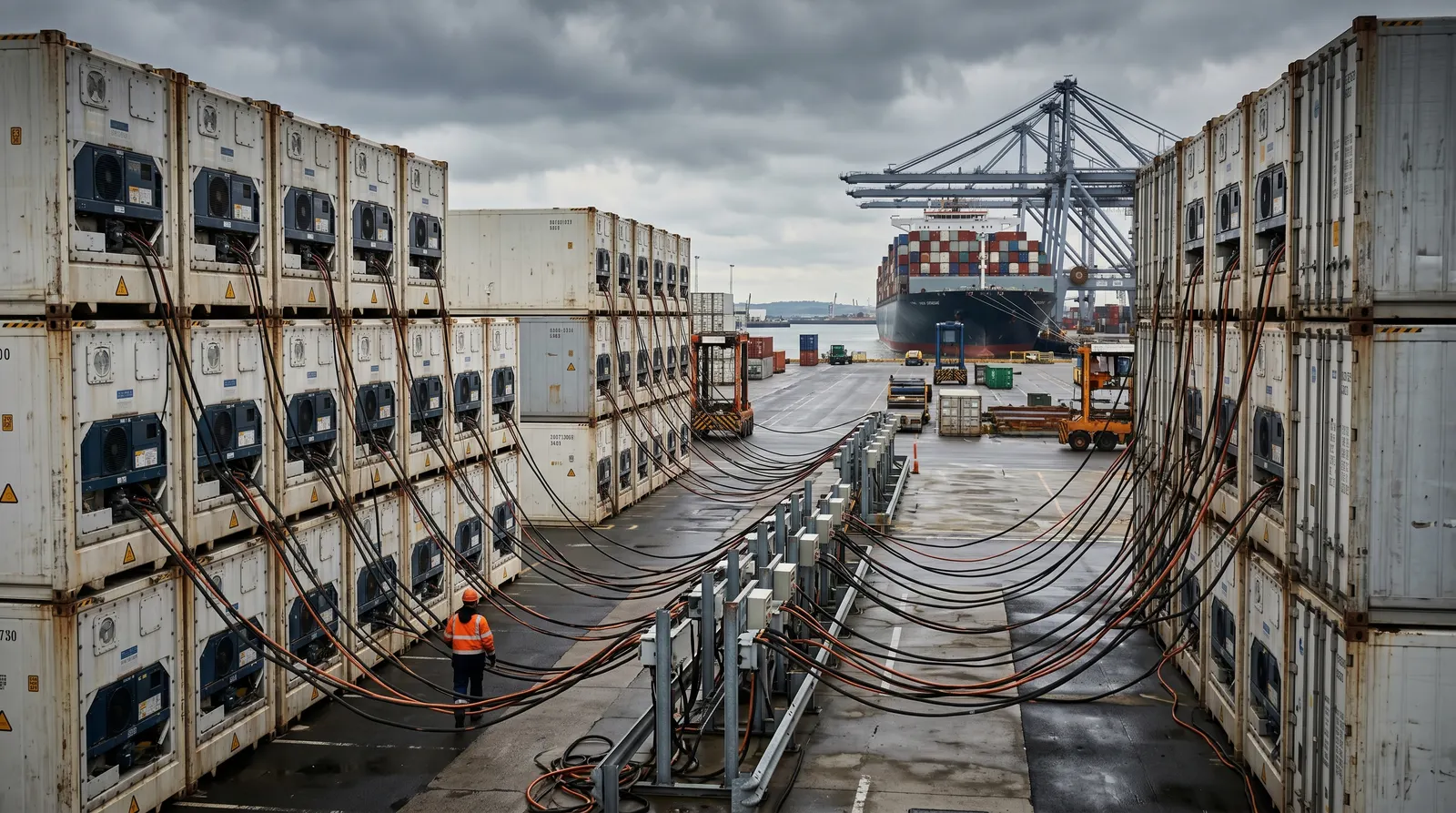
A reefer container is a standard ISO steel container fitted with an integrated refrigeration unit at one end. Unlike a passive insulated box, a reefer actively controls temperature for the duration of the voyage. The unit draws power from the vessel's electrical grid at sea — a dedicated "reefer plug" — and from quayside power points or generator sets (gensets) at terminals and during road legs.
The refrigeration unit runs continuously. This is important: a reefer container maintains cargo at a target temperature; it does not chill down warm cargo after loading. If cargo arrives at the container already warm, the unit will struggle to recover and cargo near the doors may spend hours in a thermal no-man's land. Pre-conditioning cargo before stuffing is not optional.
Container Specs: 20RF vs 40RF
Two standard reefer sizes handle the vast majority of shipments:
| Code | Length | Max payload | Internal volume |
|---|---|---|---|
| 20RF | 20 ft | 27,400 kg | 28.3 CBM |
| 40RF | 40 ft | 29,100 kg | 59.3 CBM |
Several things are worth noting when planning your booking:
- Internal volume is smaller than the equivalent dry box. The refrigeration machinery at the front of the container eats into usable floor space. A 40RF provides roughly 59 CBM versus 67.7 CBM in a 40GP. Account for this when calculating your load plan.
- Payload limits are similar to dry containers, so for most reefer commodities, cubic capacity — not weight — will be the binding constraint.
- 40RF equipment is far more common. Carrier fleets skew heavily toward 40RF. If you need a 20RF, confirm availability with your forwarder well ahead of cut-off; on many lanes it is a harder box to source and may require a longer lead time or an alternative routing.
Temperature Settings by Cargo Type
Reefer units can operate across a wide temperature range — from deep-frozen to lightly chilled — but each unit has a designed operating band. Before booking, confirm your required setpoint falls within that range and specify it explicitly on the booking instruction.
Typical setpoints by cargo category:
| Cargo type | Typical setpoint |
|---|---|
| Deep-frozen seafood, ice cream | −25 °C to −18 °C |
| Frozen meat, poultry | −18 °C |
| Chilled fresh produce | +2 °C to +8 °C |
| Bananas | +13 °C to +14 °C |
| Pharmaceuticals (cold chain GDP) | +2 °C to +8 °C |
| Wine, craft beer | +10 °C to +15 °C |
| Chemicals | varies — confirm against the SDS |
These are representative ranges only. Always verify with the shipper or the product's technical documentation. Carriers set the unit to the temperature you specify; they do not validate whether that setpoint is appropriate for your cargo.
Ventilation Settings
Respiring cargo — fruits, vegetables, cut flowers — produces CO₂ and ethylene gas as it ages. Without adequate ventilation, gas concentrations build up inside the container and accelerate spoilage. Reefer units have adjustable ventilation openings (commonly 0, 20, 40, and 60 CBM/hour) to control airflow.
State the required ventilation setting alongside the temperature setpoint in your booking. Omitting it means the carrier will default to closed — which is correct for frozen and pharmaceutical cargo but harmful for fresh produce. This is one of the most common and avoidable cold-chain errors.
Pre-Cooling: Do Not Skip It
Before loading, the container should be pre-cooled to the target setpoint — typically for at least two hours. Loading cargo into a thermally stable unit is far safer than loading into a unit that is still pulling down from ambient temperature.
Confirm three things with the stuffing party before loading day:
- The container has been pre-cooled to setpoint and the PTI (pre-trip inspection) has been completed.
- All cargo is already at the required temperature before stuffing begins.
- Loading is conducted quickly, with doors closed between pallet runs where feasible.
These steps prevent the majority of pre-departure cold-chain failures. They cost nothing beyond coordination.
Documentation Requirements
Reefer shipments carry more documentation than dry cargo. At minimum, expect to provide:
- Commercial invoice and packing list — standard across all shipments.
- Temperature and ventilation instructions — captured on the booking; some carriers use a dedicated reefer cargo instruction form.
- Phytosanitary or health certificates — required for fresh produce and meat entering most countries. Issued by a government authority; lead times can be several days, so apply early.
- Export health certificate — required for animal products in many export jurisdictions.
- GDP documentation — for pharmaceutical shipments subject to Good Distribution Practice regulations, batch release certificates and temperature monitoring device (TMD) records are typically required at destination.
- Safety Data Sheet (SDS) — for chemical cargo with specific temperature or handling requirements.
Missing certificates at origin can block gating in to the terminal; missing certificates at destination can trigger customs holds or cargo destruction. Work with your customs brokerage team to confirm the required certificates for each destination market before you confirm the booking.
What Makes Reefer More Expensive Than Dry?
Reefer ocean rates are meaningfully higher than equivalent dry-box rates. The premium reflects several distinct cost drivers:
- Equipment scarcity. Reefer boxes represent a minority of the global fleet. On lanes where reefer capacity is tight — certain Asia-Africa routes, for example — the premium can be substantial and availability can be limited even at higher rates.
- Reefer electricity (plug fee). Carriers charge for the power the unit draws from the vessel. This typically appears as a separate line item on your ocean freight quote and is non-negotiable.
- Pre-trip inspection (PTI) fee. A functional test of the refrigeration unit before loading. Expect a small PTI charge from the carrier — it verifies the unit can achieve and hold the required temperature.
- Terminal handling differential. Reefer containers require powered parking at terminals, which is more expensive to operate than standard dry stacks. THC for reefer is often slightly higher than for dry boxes at the same port.
Request a fully itemized quote so you can compare forwarders on the same basis and identify which line items are negotiable.
Planning Around Transhipment
Transhipment and reefer cargo are a risky combination. At a transhipment port, the container is disconnected from one vessel's power supply and must be reconnected at the terminal — either on powered quayside racks or on the next vessel. During a long dwell, infrastructure failures or congestion can leave a container unpowered longer than expected.
Before accepting a transhipment routing:
- Ask for the expected dwell time at each transhipment port.
- Confirm the terminal has powered reefer parks with adequate capacity.
- For frozen cargo, a single direct service is almost always worth paying a premium for — the risk of a thermal excursion at transhipment is not worth the OFR savings.
Where cargo value and frozen status justify it, book direct FCL services to eliminate transhipment risk entirely.
Reefer Cargo Insurance
Carrier liability for reefer cargo is limited to the same low caps as dry cargo under the Hague-Visby Rules — nowhere near sufficient to cover a full container of spoiled perishables or pharmaceuticals. Dedicated cargo insurance for reefer shipments typically includes a temperature deviation clause: it pays when a calibrated monitoring device records a deviation beyond the agreed temperature band.
When arranging reefer insurance:
- State the temperature setpoint and the acceptable deviation band on the insurance application.
- Confirm whether the insurer requires a calibrated temperature monitoring device inside the container — many policies make this a condition of coverage.
- Retain all PTI records and continuous temperature logs for the voyage; they are routinely required to substantiate a claim.
Without a TMD and the logs it generates, claims are difficult to prove even when the damage is evident on arrival.
A Pre-Booking Checklist
Before sending the booking request, run through the following:
- Required temperature setpoint (°C) confirmed with the shipper
- Required ventilation setting (CBM/hour) confirmed and noted on booking
- Container size (20RF or 40RF) and availability confirmed with the forwarder
- Cargo will be at temperature before loading day — pre-conditioning plan in place
- PTI to be performed before stuffing; PTI record requested from carrier
- All required certificates obtained and in-hand: phytosanitary, health, GDP documentation as applicable
- Routing reviewed for transhipment risk; direct service preferred for frozen cargo
- Cargo insurance arranged with temperature deviation coverage and TMD requirement understood
Running this list at booking time costs minutes; catching a gap after the cargo is gated in can cost the shipment.
Reefer shipping has more moving parts than dry freight, but the risks are manageable when the right steps are in place before loading. If you need help structuring a reefer booking — equipment sourcing, documentation review, or end-to-end monitoring — our special cargo team handles temperature-controlled FCL across all major lanes.