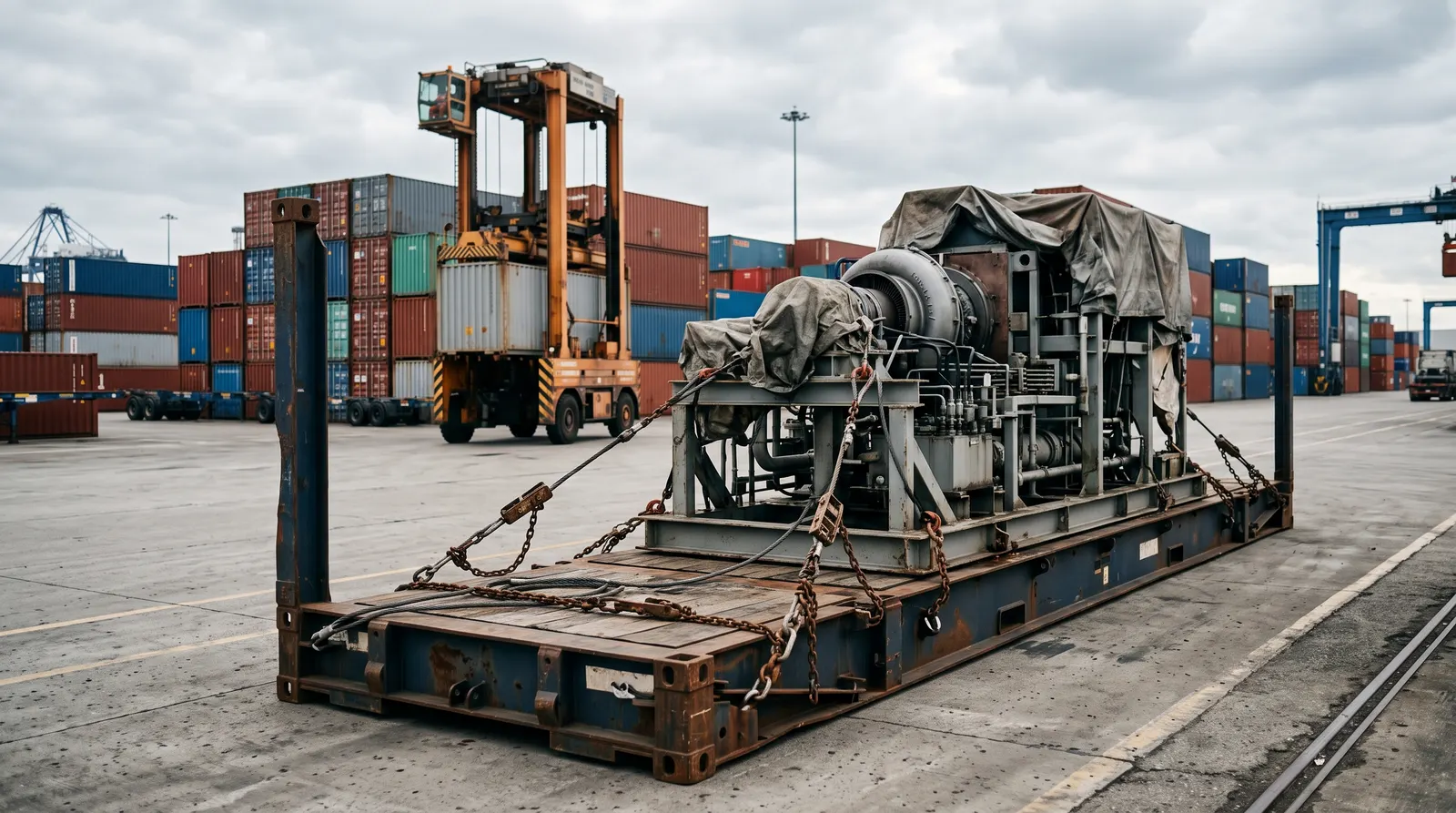
If your cargo needs a flat rack at all, it's already too wide, too long, or too awkwardly shaped for an enclosed box. The next decision — 20FR or 40FR — looks like a simple length question, but the payload gap between the two sizes is much smaller than shippers expect, and the "max volume" figure on a spec sheet barely matters once there are no side walls to define usable space. Getting the size wrong on a flat rack booking is more disruptive than on a standard container, because equipment is scarcer and stowage planning happens earlier.
This guide compares 20FR and 40FR against the numbers that actually decide the call: deck length, payload, and how out-of-gauge overhang changes the booking.
20FR vs 40FR specs at a glance
A 20FR carries up to 28,200 kg with a nominal 32.7 CBM reference volume; a 40FR carries up to 28,400 kg with a nominal 62.4 CBM reference volume. Unlike standard dry boxes, where stepping up in size buys real cubic space, a flat rack's "volume" figure is just a booking-system reference — the deck is open on both sides, so usable space is really set by the vessel's stowage plan and the cargo's own footprint, not a fixed internal cube.
| 20FR (20ft Flat Rack) | 28,200 kg max payload / 32.7 CBM nominal volume |
|---|---|
| 40FR (40ft Flat Rack) | 28,400 kg max payload / 62.4 CBM nominal volume |
The payload difference between the two sizes is only about 200 kg — under 1%. That's a much smaller gap than on general-purpose boxes, where a 40ft carries roughly 550 kg more than a 20ft. On a flat rack, size is almost entirely a length and deck-space decision, not a weight-capacity decision.
Why deck length, not volume, drives the choice
A flat rack's real capacity is its deck footprint — roughly 5.9 m long on a 20FR and 12.0 m long on a 40FR, both about 2.4 m wide — so the choice comes down to whether your cargo's actual length and shape fit that deck, not a cubic-metre target. Because there are no side walls, cargo can overhang the width on either size; the length of the deck itself is what really separates a 20FR from a 40FR.
A rough way to think about it:
- Cargo under roughly 5.5 m long that is heavy or awkwardly shaped for an enclosed box typically fits a 20FR deck with margin for lashing points at both ends.
- Cargo between roughly 6 m and 11.5 m long generally needs a 40FR — trying to force it onto a 20FR usually means unsafe overhang past the end walls.
- Cargo longer than a single 40FR deck may require two flat racks "married" end to end, a routing detail that has to be confirmed with the carrier well before booking, since not every vessel supports it.
The free cargo calculator turns your cargo's dimensions and weight into total gross weight and CBM in one step — useful for confirming you're within payload before you get to the length and stowage conversation with your forwarder.
When a 20FR is the right call
Choose a 20FR when cargo is short enough to sit fully within its deck length — roughly under 5.5–6 m — and dense or heavy enough that a smaller footprint doesn't leave stowage awkwardly underused. Typical cases:
- Compact but heavy single pieces — gearboxes, pump skids, short structural sections — that are too wide or oddly shaped for an enclosed box but don't need extra deck length.
- Cargo that's wide rather than long, where the constraint is side overhang, not the length of the unit.
- Shipments where booking a 40FR would mean paying for deck length the cargo simply doesn't use, with no length benefit to show for it.
Because the payload ceiling is nearly identical to a 40FR, there's no weight-capacity reason to step up — the only reason to choose 40FR over 20FR is length.
When a 40FR is the right call
Choose a 40FR when cargo's length exceeds what a 20FR deck can safely hold — roughly 6 m and up — even if the weight and width would otherwise fit a smaller unit. Typical cases:
- Long single pieces: process equipment skids, transformers, construction vehicles, and fabricated structural sections that need the full 12 m deck.
- Cargo loaded and lashed from the side, where the extra length gives more room for engineered lashing points along the run of the piece.
- Loads near a 20FR's length limit where a small margin for lashing hardware and end-wall clearance matters — a 40FR removes the risk of finding out at the terminal that the piece doesn't actually clear the shorter deck.
Since the payload difference between sizes is negligible, choosing 40FR over 20FR almost never costs weight capacity — it only costs the (typically higher) rate for the larger unit.
20FR vs 40FR: side by side
| Factor | 20FR | 40FR |
|---|---|---|
| Max payload | 28,200 kg | 28,400 kg |
| Nominal volume (reference only) | 32.7 CBM | 62.4 CBM |
| Approx. deck length | ~5.9 m | ~12.0 m |
| Best for | Short, heavy, or wide single pieces | Long single pieces or loads needing extended lashing runs |
| Weight advantage of larger size | None meaningful (~200 kg) | None meaningful (~200 kg) |
| Primary deciding factor | Cargo length vs. deck | Cargo length vs. deck |
Out-of-gauge cargo changes the booking either way
Cargo that extends past the flat rack's own width or height — which is common, since there are no side walls to contain it — is classed as out-of-gauge (OOG), and that status matters more than the container size once it's confirmed. OOG cargo needs:
- Vessel stowage confirmed before booking. OOG loads typically need a specific on-deck position, not a slot assigned after the fact.
- Advance notice to the port. Terminals need lead time to schedule the right crane and handling equipment for an overhanging load; late notice is the most common cause of a missed loading window on flat rack bookings.
- A pre-shipment survey and lashing plan. Many carriers make an engineered lashing and securing plan a condition of acceptance for OOG cargo, regardless of whether it's on a 20FR or 40FR.
Flag OOG status and full dimensions — including anything that overhangs the deck — at the quote stage. The special cargo team needs those numbers to confirm the booking is even workable on the size you've picked, not just to price it.
Booking considerations that apply to both sizes
A few things hold regardless of which size you choose:
- Rates run higher than dry-box FCL. Equipment scarcity, survey requirements, and OOG handling add cost on both sizes; a flat rack booking is closer to project cargo pricing than standard ocean FCL.
- Weight distribution matters more than total weight. With payload limits this close between sizes, uneven loading across the deck — not the headline kg figure — is the more common practical constraint.
- Lead time is longer. Equipment sourcing, stowage planning, and any required survey all need advance notice beyond a standard container booking.
- Insurance terms differ. With cargo exposed on an open deck, confirm your cargo insurance explicitly covers flat rack risk rather than assuming standard dry-cargo terms apply.
Getting the flat rack size right the first time means measuring the actual piece — length, width, height, and weight distribution — before booking, not estimating from the cargo's general category. Holo Cargo's operators confirm dimensions and stowage feasibility against the right equipment before the quote is finalised, so the size on the booking is the size that actually clears the terminal.