Open any ocean freight quote and you'll find a cluster of charges sitting below the base Ocean Freight Rate (OFR): BAF, CAF, sometimes EBS or LSS. Together these surcharges can add a meaningful sum per container — and they change on a schedule that has nothing to do with your shipment volume or carrier relationship. Understanding what each one recovers, and why it moves, is the first step to budgeting accurately and comparing quotes on a level footing.
What Is BAF (Bunker Adjustment Factor)?
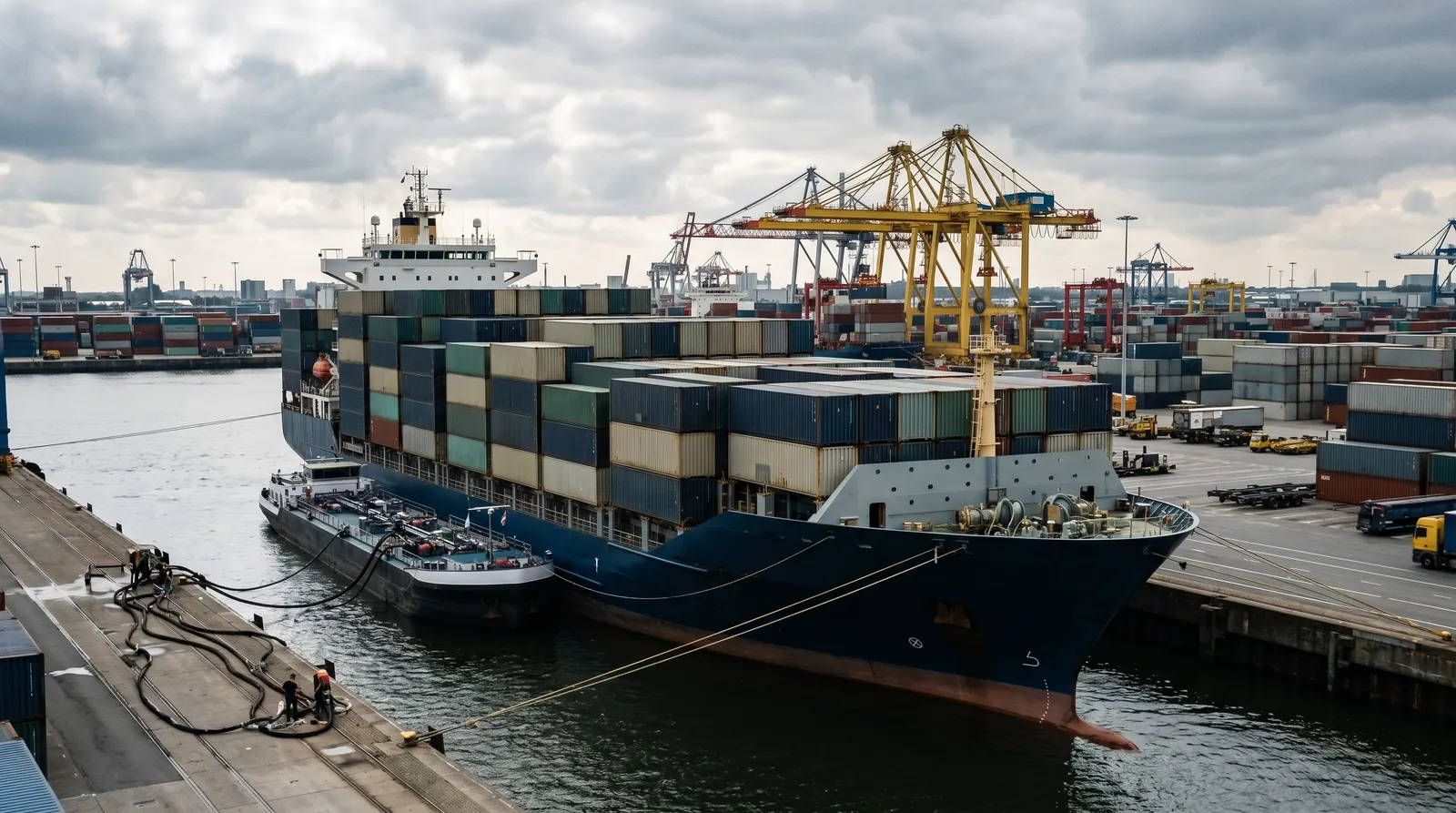
BAF is a carrier surcharge that recovers the cost of ship fuel — called bunker fuel. Ocean vessels run on heavy fuel oil or, since the IMO 2020 regulation, very low sulphur fuel oil (VLSFO). Fuel can represent 50–60% of a vessel's operating cost, and because bunker prices track crude-oil markets, they swing too sharply for carriers to bake a fixed fuel cost into the Ocean Freight Rate. Instead, carriers revise BAF quarterly or monthly against a published bunker price index.
BAF appears on a quote as a per-container charge (per TEU or FEU on FCL; per CBM on LCL). On high-volume East–West lanes — Asia to Europe or Asia to North America — BAF is often one of the largest line items after the base freight rate. The exact figure varies by carrier, trade lane, and the bunker index they reference, so you will see it differ across competing quotes even for the same port pair.
Key facts to know:
- Quoted as a firm amount valid for the quote window; recalculated at each revision cycle
- Applies to FCL and LCL shipments alike
- Non-negotiable on spot bookings; sometimes capped under annual volume contracts
- Publicly announced in advance — carriers publish their BAF revision calendars
What Is CAF (Currency Adjustment Factor)?
CAF compensates carriers for exchange-rate exposure between the currency they earn revenue in and the currencies their costs are denominated in. Most ocean freight is billed in USD, but carriers incur costs in EUR, GBP, JPY, and other currencies — port fees, crew wages, European inland handling. When the USD weakens against those currencies, carriers' USD revenues buy less.
CAF is expressed as a percentage of the OFR rather than a flat fee. On Asia–Europe lanes it appears consistently because EUR-denominated costs are large. On Trans-Pacific lanes it is less common: both the rate and the dominant port costs are USD-denominated, so the FX mismatch is smaller. Some carriers publish CAF and BAF as two separate line items; others merge them into a single "BAF + CAF" figure.
What to watch for:
- A percentage (e.g., 2–6% of OFR) rather than a flat dollar amount
- More prominent on Asia–Europe; rare or absent on Trans-Pacific
- Moves with spot or forward EUR/USD rates, so it can widen or narrow month to month
- Can technically be negative in USD-strengthening periods, though carriers rarely pass that through
IMO 2020 and the Low Sulphur Surcharge
In January 2020 the International Maritime Organization capped marine fuel sulphur content at 0.50%, down from 3.50%. Ships meeting the rule either switched to VLSFO — which costs more to produce than the legacy high-sulphur fuel oil — or installed exhaust scrubbers at significant capital cost. Either way, operating costs rose sharply.
Carriers initially added a standalone Low Sulphur Surcharge (LSS) to recover this premium. Since then, most have absorbed the LSS into updated BAF formulas, so it may no longer appear as a separate line on your quotes. If you see it, it is the same mechanism under an older label. The net effect is that post-2020 BAF levels are structurally higher than pre-2020 baselines, even when crude prices are comparable.
Emergency Bunker Surcharge (EBS)
EBS is a temporary top-up that carriers impose when fuel prices spike faster than the regular BAF revision cycle can absorb. It is announced with short notice — typically two to four weeks — and quoted as a flat per-container fee. During periods of sustained crude-oil price spikes or disruptions to major shipping routes, EBS can remain in place for several months until BAF is revised upward to account for the new level.
If you receive a quote that includes an EBS line, confirm the expiry date with your forwarder. If your shipment loads after that date, the EBS may be replaced by a revised BAF.
Why These Surcharges Change So Often
Bunker fuel prices are not set by any single carrier — they are driven by global crude markets and refined-product availability at specific bunkering ports. Carriers index BAF to recognised benchmarks (commonly the Ship and Bunker Global 20 Ports Average or similar) and update on a fixed schedule that is published months in advance.
The main drivers of BAF movement:
- Crude oil price — the dominant variable; a significant swing in Brent or WTI flows through to bunker prices within weeks
- VLSFO premium — the margin between compliant low-sulphur fuel and conventional heavy fuel oil, which varies with refinery output and demand
- Regional bunker availability — bunkering hubs like Singapore, Rotterdam, and Fujairah can diverge meaningfully, affecting lane-specific BAF
- Vessel fuel type — carriers with LNG-powered ships or scrubber-fitted fleets have different cost structures, so their BAF formulas can diverge from peers
CAF moves independently on exchange-rate calendars. A USD that weakens against EUR for several consecutive months can push CAF higher on Asia–Europe quotes even if fuel prices are flat.
Reading Surcharges on a Quote
When you receive an ocean freight quote, the cost sheet should itemise every surcharge. A typical FCL breakdown looks like this:
| OFR | Ocean Freight Rate — base per-container charge |
|---|---|
| BAF | Bunker Adjustment Factor — fuel cost recovery |
| CAF | Currency Adjustment Factor — FX exposure recovery |
| THC (origin) | Terminal handling charge at load port |
| THC (destination) | Terminal handling charge at discharge port |
| BL Fee | Bill of lading issuance |
| VGM | Verified Gross Mass weighing fee |
When comparing quotes across carriers, combine OFR + BAF + CAF into a single "all-in freight" sub-total before examining port handling. Carriers can offset a low OFR with an inflated BAF, and headline-rate comparisons that ignore fuel surcharges can be misleading by hundreds of dollars per container.
Planning for Surcharge Volatility
Surcharges that revise monthly create landed-cost risk when shipments are planned weeks ahead. Three practical ways to manage the exposure:
- Lock the quote before the next revision date. Most carriers publish their BAF calendars. Request quotes valid for 30 days and confirm that your intended ship date falls within the validity window. Booking just before a revision can capture the lower rate.
- Negotiate a BAF cap on annual contracts. If your volumes justify a service contract, push for a BAF ceiling above which the carrier absorbs the excess. This does not eliminate exposure but puts a ceiling on your worst-case scenario.
- Separate FX risk from freight risk. On Asia–Europe lanes where CAF is material, your Incoterms choice affects who holds the currency exposure: an EXW or FCA term shifts the freight booking to you, while a CIF or DAP term keeps it with your counterparty. The how shipping works guide explains move types and where cost responsibilities transfer.
For LCL shipments, every surcharge discussed here is expressed per CBM rather than per container. The logic is identical, but since a single cubic metre represents a small fraction of a container, the absolute numbers are smaller — though they compound quickly on large consolidated shipments. See consolidation for how co-loading affects the per-unit cost.
What to Do With an Unfamiliar Surcharge
Quotes sometimes include surcharge codes you have not seen before: PSS (Peak Season Surcharge), PCS (Panama Canal Surcharge), WRS (War Risk Surcharge), or carrier-specific codes. Never accept a quote with unrecognised line items without asking for a written explanation. Unexplained surcharges are among the most common reasons landed-cost budgets overrun.
A clear, itemised quote is not a favour — it is a basic requirement. Before accepting, confirm: what period each surcharge covers, whether it is fixed for your booking, and what happens if your ship date changes and the rate schedule rolls over.