You booked ocean to save money, and the cargo is going to arrive too late for the sales window. Air would make the date, but the freight bill would erase the margin. That squeeze is exactly where sea-air freight earns its place, and it is often overlooked until the deadline is already tight.
What is sea-air freight?
Sea-air freight is a combined routing: cargo travels by ocean from the origin port to a transfer hub, is unloaded and re-processed, then flies the final leg to the destination. It trades some of air's speed for a lower price than flying the whole way, and it is faster than staying on a vessel the entire journey.
It is a form of multimodal shipping, with one important difference from a typical ocean-plus-truck move: both legs are long-distance modes, and the handoff happens at a hub chosen because it has good ocean and air connections.
The cargo usually moves under one through-booking, so you deal with one set of documents rather than arranging two separate shipments.
How does the routing work?
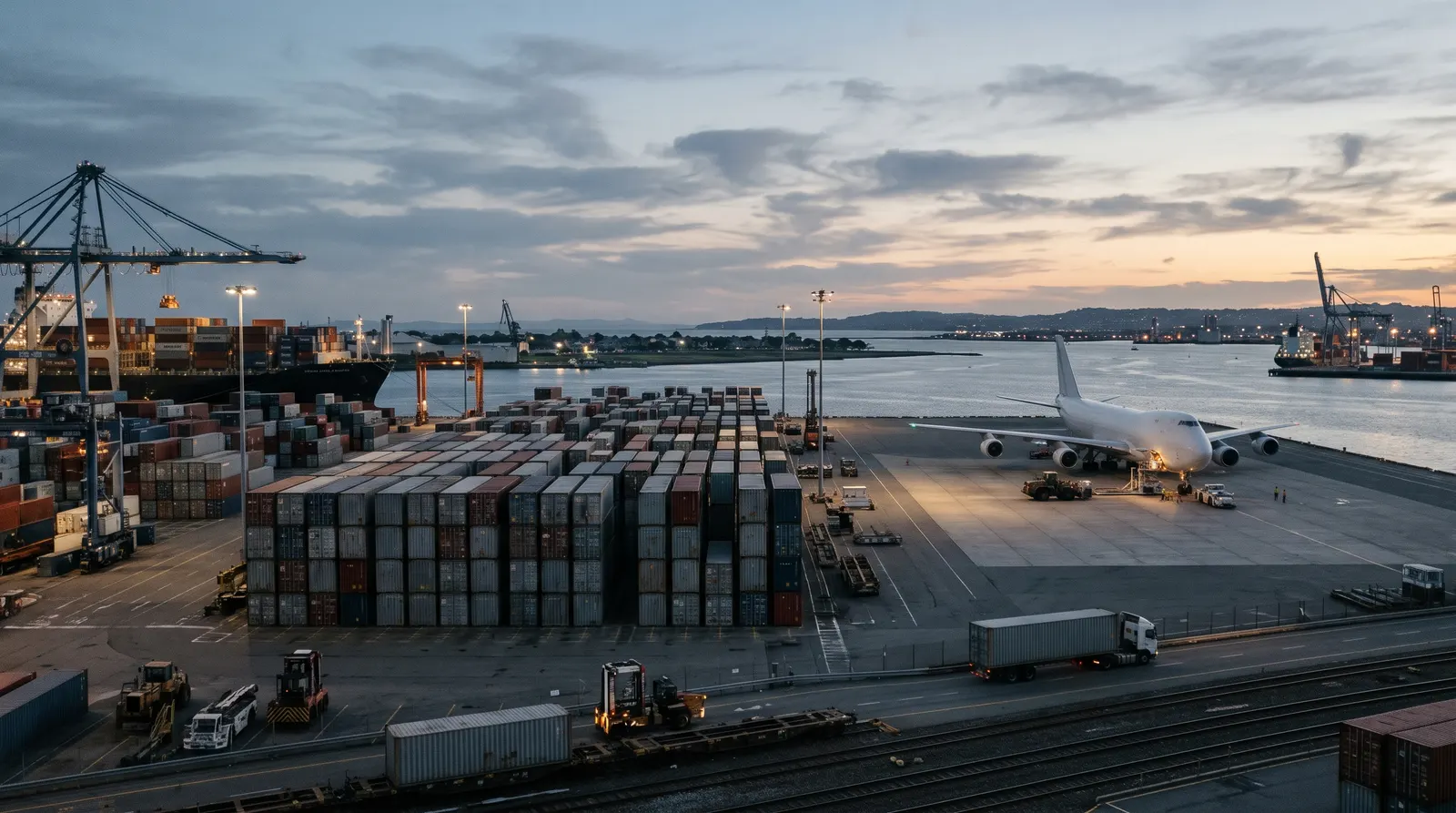
The cargo is collected at origin, shipped by sea to a gateway hub, transferred to an airport (often close to the port), and flown to the final destination. Customs and handling steps at the hub vary by location.
A typical flow looks like this:
- Origin pickup and export formalities. The cargo is collected, documents are prepared, and the goods are gated in for the vessel.
- Ocean leg. The cargo sails to the transfer hub, often as LCL or FCL depending on volume.
- Transfer at the hub. Cargo is devanned, re-palletised or re-packed to air specifications, and screened for air carriage.
- Air leg. The shipment flies to the destination airport.
- Destination clearance and delivery. Import customs clearance and the final delivery to the consignee.
Because the cargo changes mode in the middle, the hub matters. A well-run hub with ocean and air operations close together keeps the transfer short. A poorly connected one eats the time you were trying to save.
How does it compare with pure ocean and pure air?
Sea-air sits between the two: faster than ocean from end to end, and typically less expensive than air for the same cargo. The exact gap depends on lane, season, and the hub used, so treat any comparison as indicative until you have a quote.
| Factor | Ocean | Sea-air | Air |
|---|---|---|---|
| Speed | Slowest | Middle | Fastest |
| Cost per kg | Lowest | Middle | Highest |
| Handling steps | Fewest modes | Two modes plus a transfer | One mode |
| Suited to | Bulk, non-urgent | Time-sensitive but cost-aware | Urgent, high-value |
| Risk of delay | Port congestion, rolled cargo | Transfer timing at the hub | Capacity, cut-offs |
For reference, indicative transit on a long-haul ocean move runs around 35 days, while long-haul air runs around 5 days. Sea-air lands between those figures, and the real number depends on the hub and how quickly the transfer is done. Your quote and booking confirmation will show the actual schedule.
When does sea-air make sense?
Sea-air makes sense when the cargo is worth moving faster than ocean but the air cost for the full journey is hard to justify. It usually suits mid-value goods, seasonal products, and replenishment orders that have slipped behind schedule.
Good fits include:
- Seasonal stock that missed the ocean cut-off but does not need an express flight.
- Replenishment orders where the shelf is running low and a three-to-five week ocean move is too long.
- Mid-value, mid-weight goods such as apparel, accessories, consumer electronics accessories, and home goods.
- Shipments from origins that are far from the destination, where the ocean leg covers the cheap long distance and the air leg only covers the final stretch.
It is a weaker fit for:
- Very urgent cargo. If it must arrive in days, book air direct.
- Heavy, dense, low-value cargo. Ocean is cheaper and the speed gain rarely pays for itself.
- Dangerous goods and special cargo. These need approval on both modes, which can limit options. Check special cargo requirements early.
- Cargo that does not meet air carrier size or weight limits after the transfer.
What does it cost, and how are charges built?
Sea-air is priced as two linked legs: an ocean portion and an air portion, plus handling at the transfer hub. Rates vary by lane, season, hub, and carrier, so there is no universal figure.
Expect charges from both worlds on the quote:
- Ocean-side charges such as ocean freight, terminal handling, and bill of lading fees.
- Air-side charges such as air freight per chargeable kilogram, fuel and security surcharges, and the air waybill fee.
- Transfer handling at the hub.
- Destination customs and delivery charges.
The air leg is priced on chargeable weight, which is the greater of actual and volumetric weight. If your cargo is bulky, that can change the economics, so work out the numbers before you commit. The free cargo calculator computes your CBM, gross weight, and chargeable weight from carton or pallet dimensions.
Customs duties and taxes are assessed by customs at entry and are separate from the freight quote.
What should you check before booking?
Confirm the transfer hub, the cut-off times on both legs, the packaging requirements for air, and who handles customs at each point. These four items cause most of the surprises.
- The hub and its connections. Ask which hub is used and how often air capacity leaves it. A weekly flight turns a fast routing into a slow one.
- Cut-offs. The ocean leg and the air leg each have their own deadlines. A late vessel can miss the booked flight.
- Packing. Air carriers have limits on piece size, weight, and packaging. Cargo built for a container may need re-packing at the hub.
- Documents. Make sure the commercial invoice, packing list, and any permits match across both legs. Mismatches slow the transfer.
- Insurance. Cargo changes hands and handling mode in the middle of the journey. Discuss cargo insurance before it ships, and read the terms the insurer sets.
- Who owns the cargo at each stage. Your Incoterm decides who pays for and manages each leg. See the Incoterms guide if you are unsure.
How does sea-air compare with other in-between options?
Sea-air is not the only way to bridge the gap between speed and cost.
- Expedited ocean services use faster vessels or priority handling, but remain ocean-only.
- Rail can be an option on some corridors. See our rail freight service.
- Splitting the shipment lets you fly the urgent part and ship the rest by ocean.
- LCL versus air is worth comparing for small shipments, where the cost gap can be smaller than expected.
Sometimes the best answer is a split: send the units you need first by air or sea-air, and the balance by regular ocean.
How Holo Cargo helps
When a shipment needs a faster option than ocean, our operators compare ocean, air, and combined routings for your lane and send an itemised quote, so you can see what each choice costs and how long it should take. The charges we quote are the charges you pay, and we tell you when the cargo moves so you are not left chasing. You can read more about our air freight service.