Every dangerous goods shipment gets sorted into one of nine IMDG hazard classes before a carrier will even quote it. That class — not the product name on your commercial invoice — is what a carrier's booking system actually reacts to. It decides whether the container can go on the next sailing, whether the line will accept it at all, and how many extra charges land on your quote. Two shipments that look similar on paper (both "chemicals," both "batteries") can carry very different costs once you know which class they fall under.
This guide walks through what each of the 9 IMDG classes means operationally and financially, so you know what to expect before your forwarder sends the quote back.
What the IMDG class actually controls
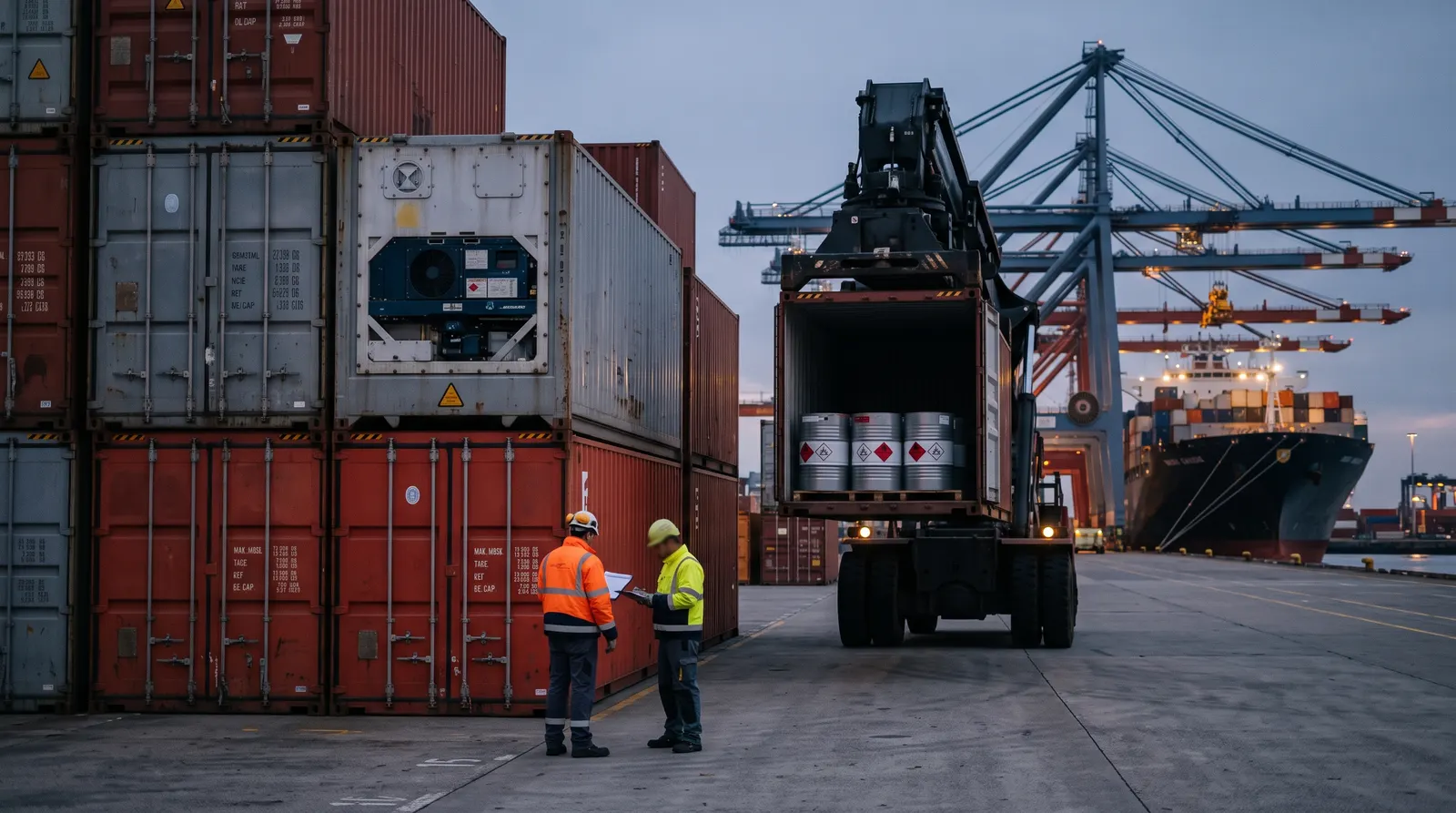
The IMDG class is not paperwork trivia — it is the input a carrier's system uses to decide acceptance, stowage, and price. The International Maritime Dangerous Goods (IMDG) Code assigns every hazardous substance a class (1 through 9), often a division within that class, and a four-digit UN number. Carriers use the class to determine which vessels and stow positions can take the cargo, which other cargo it must be kept away from, and which surcharge tier applies.
In practice, the class matters more than the cargo description. A "flammable liquid" and a "corrosive" might sit in the same shipping carton category to a warehouse clerk, but to a carrier's IMDG-compliance system they are entirely different bookings — different segregation rules, different accepted vessels, different price.
The 9 classes and what they mean for booking
| Class | Hazard | Typical cargo | Booking impact |
|---|---|---|---|
| 1 | Explosives | Fireworks, flares, ammunition | Individual carrier approval; few sailings accept it |
| 2 | Gases | Aerosols, LPG, dry ice, oxygen cylinders | Segregation from ignition sources; division-specific limits |
| 3 | Flammable liquids | Paints, solvents, adhesives, perfumes | Widely accepted; moderate surcharge tier |
| 4 | Flammable solids / self-reactive / pyrophoric | Matches, metal powders | Restricted stow positions; deck-only on some services |
| 5 | Oxidizers and organic peroxides | Ammonium nitrate, hydrogen peroxide | Strict segregation from flammables and food cargo |
| 6 | Toxic and infectious substances | Pesticides, clinical waste | Documentation-heavy; limited carrier list |
| 7 | Radioactive material | Medical isotopes, industrial gauges | Case-by-case carrier approval; longest lead time |
| 8 | Corrosives | Acids, alkalis, wet-cell batteries | Widely accepted; packaging-driven cost |
| 9 | Miscellaneous | Lithium batteries, dry ice, magnetized goods | Highest shipment volume of any class; fast-growing surcharge category |
Classes 1, 7, and (for some divisions) 5.2 sit at the restrictive end. Expect a smaller pool of carriers willing to quote at all, individual approval before the booking is confirmed, and premium pricing that reflects the liability and stowage exposure. Classes 3, 8, and 9 sit at the accessible end — most major carriers run standard DG services for these, though the surcharge still applies.
Why Class 9 dominates most quotes
Class 9 — "miscellaneous dangerous goods" — is the class most shippers actually encounter, mainly because of UN3480 (lithium-ion batteries shipped alone) and UN3481 (batteries packed with or contained in equipment). Consumer electronics, e-bikes, power tools, and EV components all route through Class 9. Because the volume is so high, carriers have built standard Class 9 surcharge tiers and acceptance processes — it is the easiest class to book, but it is still a DG booking with its own cut-off and paperwork, not general cargo.
Dry ice (UN1845), also Class 9, is a separate and common trap: it is used as a coolant for temperature-sensitive Class 9 or general cargo but is itself declarable and subject to quantity limits per container due to CO2 off-gassing in an enclosed space.
Packing groups: the second variable that sets price
Most classes are further split into three packing groups (PG I, II, III) that indicate severity — and packing group affects packaging spec, quantity limits, and carrier acceptance as much as the class itself does.
| PG I | High danger — strongest UN-certified packaging required; lowest carrier acceptance |
|---|---|
| PG II | Medium danger — broadly accepted; moderate packaging spec |
| PG III | Minor danger — widest carrier acceptance; most cost-efficient to book |
Two shipments in the same class can land very different quotes once packing group is factored in — a PG III corrosive books like routine DG cargo, while a PG I corrosive of the same class may need special stowage and a smaller pool of willing carriers.
Surcharge lines you'll see on a DG quote
Carriers price dangerous goods separately from the base freight rate because of the added handling, segregation, and liability exposure. A typical DG ocean quote adds:
- DG Surcharge (DGS) — the primary per-container (FCL) or per-shipment (LCL) hazmat levy; rate tier depends on class and packing group
- DG Handling Fee — origin/destination terminal charges for checking, labelling verification, and physical segregation
- DG Documentation Fee — some carriers charge separately to process the Dangerous Goods Declaration through their compliance systems
- High-hazard premium — Class 1 and Class 7 (and some Class 5.2/6.1 divisions) commonly attract additional fees tied to individual carrier approval rather than standard tariff pricing
These are itemised freight and handling charges — your quote reflects what the carrier and terminal actually levy for moving DG cargo, not a prediction of customs duty or clearance cost.
Lead time: the cost most shippers underestimate
The most expensive mistake with a DG booking is rarely the surcharge — it's missing the DG cut-off, which typically falls 24–48 hours before the standard cargo cut-off, and rolling to the next sailing. For higher-hazard classes (1, 5.2, 7, and some 2.3 divisions), vessel space with the right stow position and segregation clearance fills faster than general DG space, so booking typically several weeks ahead is worth building into your planning for those classes specifically. Class 3, 8, and 9 cargo generally books on normal DG timelines as long as documentation is in order.
Before locking in mode and routing, it helps to know your actual chargeable figures — the free cargo calculator computes your CBM, gross weight, and chargeable weight from carton or pallet dimensions, which your forwarder needs alongside the UN number and class to confirm carrier acceptance.
Ocean vs. air: the class picture shifts
IMDG governs ocean; air freight follows the separate IATA Dangerous Goods Regulations, which are stricter on quantity limits and packaging for most classes and outright prohibit some substances that ocean will accept. A UN number cleared for ocean under IMDG is not automatically cleared for air freight — check both codes independently before assuming a routing works. Lithium batteries are the clearest example: watt-hour and state-of-charge thresholds determine whether a shipment is barred from passenger aircraft, restricted to cargo-aircraft-only service, or prohibited outright.
What to confirm before you request a quote
- UN number and hazard class — from the Safety Data Sheet, not the product label
- Packing group — drives packaging spec and carrier acceptance
- Net and gross quantity — per package and total per container
- Whether the class needs individual carrier approval — Classes 1, 7, and select 5.2/6.1 divisions typically do
- Target sailing date vs. DG cut-off — build in the extra 24–48 hours
Confirming these upfront means your forwarder can quote in a single pass instead of iterating on class, packaging, and carrier acceptance one round at a time — which is where DG bookings usually lose the most days.
Our special cargo service and customs-brokerage partners verify class, packing group, and documentation against carrier requirements before a DG quote goes out, so the class and surcharges you see are what actually gets booked — not a placeholder that changes later.