Not every shipment fits inside a closed steel box. Machinery that exceeds standard door height, cargo that needs to be loaded from above with a crane, or a load that is wider than any container's internal walls all need equipment built around the cargo, not the other way round. Open top and flat rack containers solve this — but they solve different problems, and picking the wrong one costs time at the terminal, not just money.
This guide compares both container types against the specs that matter, and lays out when each is the right call.
What Is an Open Top Container?
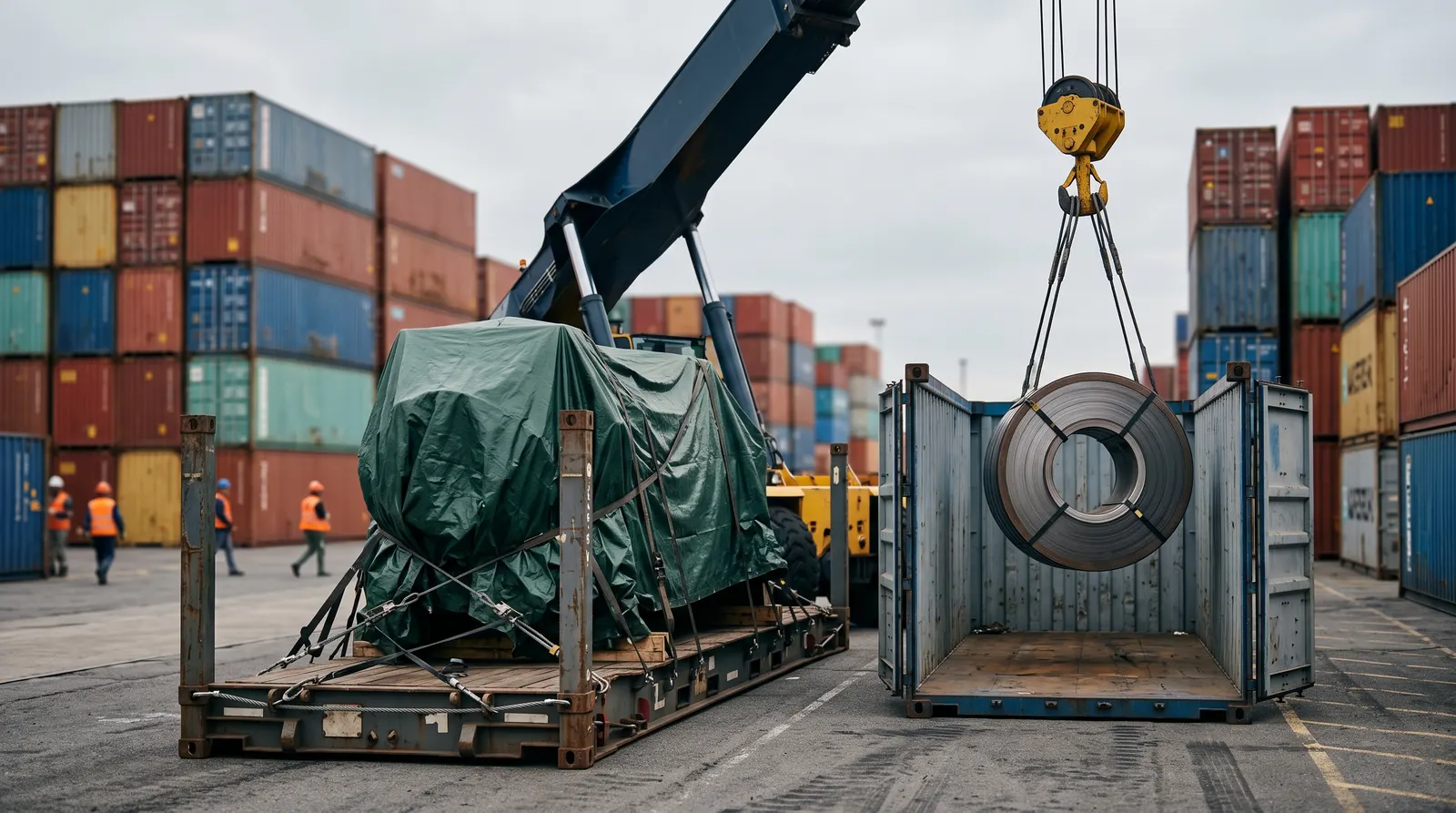
An open top container is a standard steel box with a removable tarpaulin (or hard) roof instead of a fixed one. The side walls, floor, and door end are the same as a general-purpose container — only the roof is different. This means cargo is loaded vertically, from above, by crane or gantry, rather than through the door end.
Open top containers come in two standard sizes:
| Code | Max payload | Max volume |
|---|---|---|
| 20OT | 28,100 kg | 32.5 CBM |
| 40OT | 28,600 kg | 66.7 CBM |
Because the side walls and floor are unchanged from a general-purpose box, an open top behaves like a standard container for stacking and lashing purposes once the roof cover is secured — the difference is entirely in how cargo gets in.
What Is a Flat Rack Container?
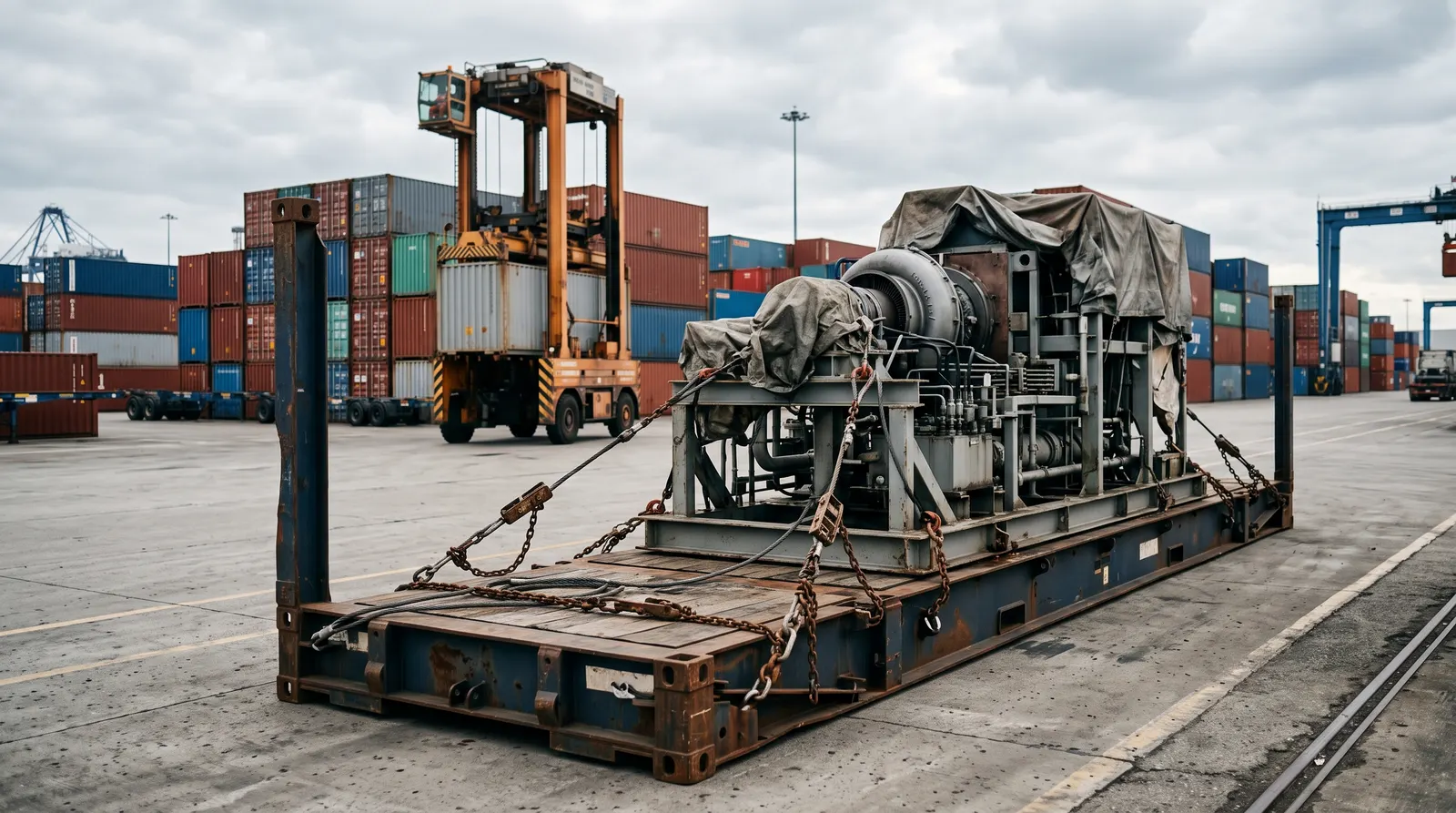
A flat rack container strips away the roof and both side walls, leaving only a reinforced floor and two end walls (which are often collapsible for empty-return positioning). There is no enclosure at all — cargo sits exposed on the deck and is lashed directly to lashing points built into the floor structure.
Flat rack sizes and specs:
| Code | Max payload | Max volume |
|---|---|---|
| 20FR | 28,200 kg | 32.7 CBM |
| 40FR | 28,400 kg | 62.4 CBM |
The "max volume" figure for a flat rack is a nominal reference for booking systems — since there are no side walls, actual usable space is really defined by the vessel's deck stowage plan and the cargo's own footprint, not a fixed internal cube.
Open Top vs Flat Rack: Side by Side
| Factor | Open Top | Flat Rack |
|---|---|---|
| Enclosure | Full side walls and floor, removable roof | Floor and end walls only, no sides |
| Loading method | Top-loaded by crane through the open roof | Loaded from the side or top; no door restriction |
| Best for | Tall cargo that exceeds standard door/roof height | Wide or oddly shaped cargo that will not fit any enclosed box |
| Weather exposure | Partial — tarpaulin cover once loaded | Full exposure unless cargo is separately wrapped/crated |
| Max payload (20ft / 40ft) | 28,100 kg / 28,600 kg | 28,200 kg / 28,400 kg |
| Max volume (20ft / 40ft) | 32.5 CBM / 66.7 CBM | 32.7 CBM / 62.4 CBM |
| Out-of-gauge handling | Height overhang only (cargo can exceed roofline with tarpaulin removed or raised) | Height and width overhang (cargo can exceed both the top and the sides) |
| 20OT | 28,100 kg max payload / 32.5 CBM max volume |
|---|---|
| 40OT | 28,600 kg max payload / 66.7 CBM max volume |
| 20FR | 28,200 kg max payload / 32.7 CBM max volume |
| 40FR | 28,400 kg max payload / 62.4 CBM max volume |
When Open Top Is the Right Call
Choose an open top container when the cargo's problem is height, not width, and it can still be lowered in from above and settled inside the container's footprint. Typical cases:
- Tall machinery, industrial coils, or fabricated structures that exceed a standard door height but fit within the container's width and length.
- Cargo that must be craned in vertically rather than forklifted through the door end — bulky castings, pressure vessels, or awkward single pieces.
- Loads that need partial weather protection: the tarpaulin cover, while not fully sealed, still shields cargo from rain and spray better than an open deck.
Once loaded, the roof cover (or bows and tarpaulin) is fitted and the container is lashed and sealed much like a general-purpose box, which keeps stacking and stowage planning relatively straightforward for the carrier.
When Flat Rack Is the Right Call
Choose a flat rack when cargo is too wide, too long, or too irregularly shaped to sit inside any enclosed container — the load genuinely needs open sides, not just an open roof. Typical cases:
- Wide loads such as construction vehicles, transformers, or process equipment that overhang the container's width.
- Cargo loaded from the side rather than from above, or cargo whose shape makes a top-loaded, walled box impractical.
- Two flat racks can sometimes be "married" (placed end to end) to carry cargo longer than a single unit — a routing detail to confirm with your forwarder well before booking, since not every carrier or vessel supports it.
Because there is no enclosure, flat rack cargo is fully exposed to weather and handling at every port and transhipment. Crating, wrapping, or corrosion protection is typically the shipper's responsibility, not the carrier's.
Out-of-Gauge (OOG) Cargo: What Changes
Cargo that physically exceeds the container's own dimensions — extending past the roofline on an open top, or past the side walls on a flat rack — is classed as out-of-gauge (OOG). OOG changes the booking in a few concrete ways:
- Vessel stowage. OOG cargo needs specific stowage positions (commonly on deck, away from other stacks) confirmed before booking, not after.
- Port handling. Ports need advance notice to schedule the right crane and handling equipment; last-minute OOG bookings are the most common cause of a missed loading window.
- Surveys. A pre-shipment survey and lashing/securing plan is standard practice for OOG loads, and some carriers make it a condition of acceptance.
If your cargo is OOG on either equipment type, flag it at the quote stage — the special cargo team needs the full dimensions and weight distribution to confirm the booking, not just to price it.
Booking Considerations for Both
A few things apply regardless of which equipment you choose:
- Weight distribution matters as much as total weight. Both open top and flat rack containers have payload limits close to a standard general-purpose box, but uneven weight distribution across the floor is a bigger practical constraint than the headline payload figure — get an engineered lashing and load plan for anything irregular.
- Rates are typically higher than dry-box equivalents. Equipment scarcity, survey requirements, and OOG handling all add cost; treat open top and flat rack quotes as project cargo-adjacent rather than standard FCL pricing.
- Lead time is longer. Between equipment sourcing, stowage planning, and any required surveys, oversized cargo bookings need more advance notice than a standard ocean FCL container. Build that into your shipping schedule, not just your budget.
- Insurance terms differ. With cargo exposed on deck or partially uncovered, confirm your cargo insurance policy explicitly covers open top and flat rack risk profiles rather than assuming standard dry-cargo terms apply.
Which One Do You Need?
If the cargo fits within the container's width and length but is too tall for a standard door, or needs to be craned in from above, an open top is almost always the simpler and cheaper choice. If the cargo is wider than the container itself, or its shape rules out any enclosed box, a flat rack is the only option — there is no open top variant wide enough to substitute.
When in doubt, share full dimensions, weight, and a photo of the cargo with your forwarder before booking. Equipment and stowage decisions made on incomplete dimensions are the single biggest cause of delays and rebooking on oversized shipments.
Getting oversized cargo booked correctly the first time means confirming equipment, stowage, and lead time before you commit — not discovering a mismatch at the terminal.